
Music as a Language Beyond Speech
On Chesil BeachThis thread traces music as Florence’s confident medium of judgment and connection, contrasting her expressive musical life with the couple’s inability to communicate about intimacy.
increasing Bearing strength in each event
 decreasing
Bearing strength in each eventdecreasingThe Musician’s Confidence
The Musician’s Confidence
A Defined Form of Expression
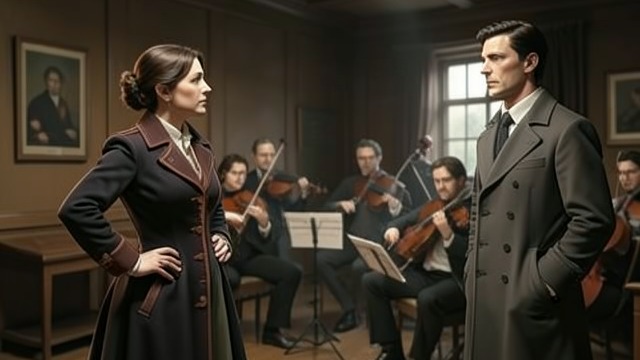
At the Royal College of Music and in the rehearsal rooms she inhabits, Florence develops a life organized around practice, listening, and interpretation. Music gives her standards she can trust: phrasing, tone, and timing can be debated through shared work.
Authority Through Art
As a violinist, Florence is decisive where she often feels uncertain elsewhere. She can listen to competing views, make a choice, and lead her colleagues without apologizing for her judgment. Music offers a model of communication in which difference can be expressed directly and resolved through attention.
The Quartet Takes Shape

The Quartet Takes Shape
A Difficult Question
A discarded performance note from the Amadeus Quartet draws Florence’s attention to a musical problem and helps prompt her to assemble a group of strong players. The work of founding the Ennismore Quartet gives her a demanding purpose beyond the limited employment she fears may be available.
Leadership Through Listening
The group does not become cohesive automatically. Florence’s resolve brings players together, while rehearsal lets disagreement become useful rather than destructive. Her musical identity depends on both authority and collaboration, qualities she will later struggle to carry into the private conversations she avoids with Edward.
A Question in Mozart

A Question in Mozart
Music as Inquiry
The opening of the Mozart quintet returns to Florence as a phrase that seems to ask a question without supplying words. Its repeated inquiry and uncertain answers give musical form to a kind of uncertainty she cannot comfortably articulate in ordinary conversation.
A Private Resource
In the bedroom on her wedding night, Florence remembers the piece and the decisive musician she has been in rehearsal. For a moment, music recalls her ability to identify a problem and state what she wants. Yet the memory cannot itself break the silence between the couple; artistic clarity remains easier to access than intimate speech.
A Promise of Performance

A Promise of Performance
A Shared Point of Attention
Edward gradually learns to hear patterns in chamber music and tells Florence honestly when a rehearsal has moved him. In response, she imagines the Ennismore Quartet performing at Wigmore Hall and promises that the Mozart quintet will be played for him.
Connection Without Translation
Music briefly creates a bridge between their different sensibilities. Edward’s interest remains partial, and Florence’s musical ambitions are not fully his own, but he makes an effort to enter her world. Their shared attention to music shows that intimacy can grow through patient listening, a practice they fail to apply to their sexual fears.
The Empty Seat
The Empty Seat
A Career Fulfilled
The Ennismore Quartet eventually gives the successful Wigmore Hall performance Florence once described to Edward. Her musical life reaches a public accomplishment that he had promised to witness, but the marriage’s collapse has carried him elsewhere.
An Audience Imagined
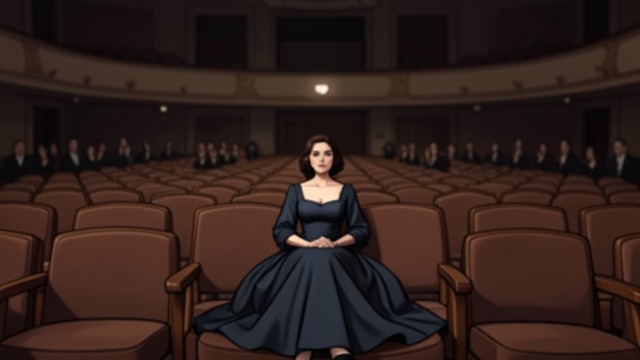
During the applause, Florence’s gaze travels toward the seat Edward once chose as his place. The empty seat joins artistic fulfillment to private loss: music has given her a career and a language of expression, but cannot repair the relationship that might have listened to her promise. Her remembered audience survives as an absence inside the triumph.
During Florence’s student years, before her meeting with Edward
During Florence’s final year at music college
During a rehearsal of the Mozart quintet, before the wedding
During the courtship, after Edward attends a quartet rehearsal
At the Ennismore Quartet’s Wigmore Hall debut, in the late 1960s
